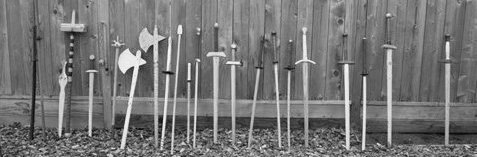
Combat Rules of The Western Circle:
- You must come in one solid color and bear your ranks visibly on any WCoS field, class or at any
event.
- The armor requirements: (You MUST wear) helmet, gloves, long sleeves, long pants and groin
protection (men). Optional armor: body, bracers (forearms), tare, lower legs. Steel combat requires
every item listed above plus a gorget, steel gauntlets and a steel helm when indicated in the steel
rank requirements.
- A Kaiden must approve weapons of all types prior to their first use in combat.
- Wood swords in make, must in length be an exact replica of a (steel) sword within your possession or
one you wish to obtain. Beginners and those that train, but do not yet own steel, must use the bokken
they are trained with or provided by a Kaiden.
- Combat rules: All shots are open (except the base of the neck/back of the head), even back attacks.
Full speed, full contact is okay, control when possible. ("Control" -is not using excessive force or
striking in unarmored areas and being aware of the possibility for injury). Do not act with gross
negligence to the possibility of serious injury.
- Areas that are considered to be an instant kills: any full circle cut to the head, body, neck,
arms/shoulders or legs (arm and leg cuts must be in position to sever the limb). Any full chop cut to
the same areas. Thrusts to the neck, chest, body, groin or any direct thrust to a main artery
(includes femoral artery in the legs and subclavian and brachial arteries in the arms/shoulders).
Thrusts to the face are kills when delivered by someone of the appropriate level (L5 and above). Any
draw cut to the inner upper legs, inner upper arms, soft area of the stomach, or throat/neck. Any
short circle cut to the neck.
- A person receiving a strike can opt to take it as a kill even if the person who struck does not feel
it was adequate. In all cases the person who received the strike should call it by target ("Body",
"Arm", "Head", etc) and the person who delivered the strike should decide its validity ("Kill",
"Wound", "Nothing", etc). Marshals are the final judge and will settle any confusion.
- Red Ropes and above can strike to the hands and begin fighting with steel, once trained to do so.
- Crimson Chains and above may thrust to the face once trained to do so.
- Beware of deadly/excessive force. A lack of awareness about an unarmored or weakly armored area, or
a simple mistake can have terrible consequences.
- Be honorable about wounds taken. Take wounds immediately to give the most realistic combat
environment. Wounds are when you have been hit with a weak or short cut, or a cut that would not sever
the arm or leg (as applicable). Your opponent may not make you take a wound if they believe their cut
was insufficient. Quick and decisive communication is key here.
- Address people by name title if they have one. Kaiden, Honorary Kaiden, teacher, sensei, etc. or
their sword name.
- Never throw your sword.
- Anything may be used as a weapon on the field (rock, dagger, stick, etc.) within reason.
- Talking is allowed. Battle is one of the few areas in class where you are free to act and speak as
you wish (without cursing). Verbal tactics in battle such as taunting, boasting, screaming are
allowed. Just remember battle should be treated as reality, this is not a time to joke. Have purpose
in all your actions.
- Fight hard for the purpose of training and knowledge. Treat all swordsman/women equally regardless
of size, gender or age.
Swords:
a. All bokkens must be made out of hickory or another similar light hardwood such as oak or ash. Bokkens
may be made of any other type of hardwood, but these can only be used for one-on-one combat and with the
other person's approval. Tips must be fairly blunt in both cases.
b. Steel swords must have a rounded dull edge and a blunted tip. They must be kept in good order and
approved by a Kaiden prior to their first use.
c. Other types of swords are usable by the students, but a student should seek a Kaiden's advice before
sparring with a new weapon. Different sparring weapons have different lessons. All have some worth. Other
weapons acceptable for various types of specialized sparring are: rattan (sca), bamboo (shinai), foam
(boffer), foils (fencing).
d. At no time are any alloy or plastic swords allowed in WCoS combat. Plastics include: ABS,
polycarbonate, etc. Alloys include: aluminum, brass, copper, etc. Titanium and bronze are by Kaidens
approval only. This is an issue of respect.
Special Events: Melee battles, team combat and scenario battle have
special rules that are dictated by the swordsman running the day.